
Choosing materials in a kitchen is not just an aesthetic decision; it is a technical prescription. In no other area of the home do so many simultaneous aggressions converge: constant humidity, sudden thermal changes, chemical abrasion (cleaning), mechanical impact, and grease.
For architects and interior designers, the challenge is not only to design a beautiful kitchen, but to ensure that in five years it still remains so. A poorly specified material is a guaranteed future claim.
In this technical guide, we analyze the most commonly used substrates and finishes, their real mechanical properties, and how to select them with professional criteria to balance durability, design, and budget.
1. Preliminary Analysis: Specify According to Use
Before opening the sample catalog, the professional must define the kitchen’s “stress profile.” A kitchen for a couple who barely cooks is not the same as one for a large family with intensive use.
Critical variables to define in the project:
- Water Area: Requires materials with PUR or laser edge sealing to prevent swelling.
- Cooking Area: Needs thermal resistance and easy grease cleaning.
- Maintenance Expectations: Is the client willing to oil a wooden countertop every 6 months or do they want “zero maintenance”?
Teowin Tip: Using software that links design to a materials database allows precise budgeting. If you change from “Laminate” to “Lacquer” in the 3D design, the cost and technical breakdown must update automatically.
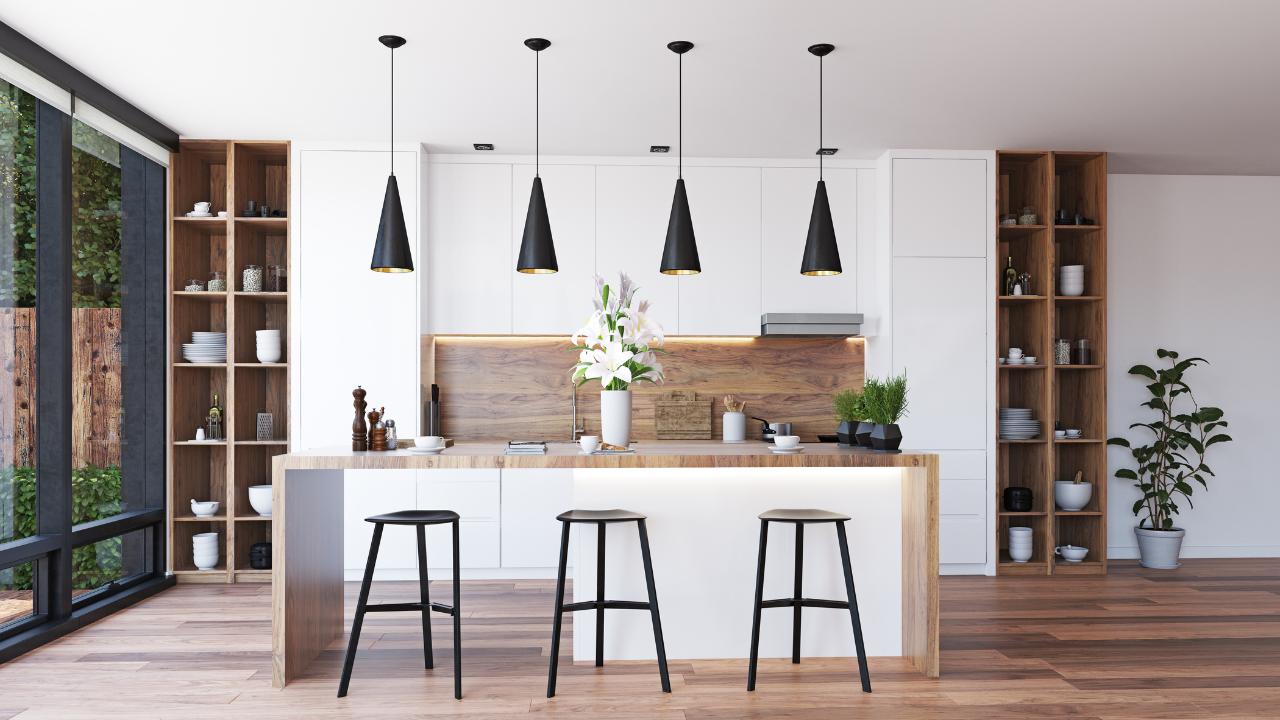
2. Materials for Doors and Fronts (The Skin of the Kitchen)
This is the most visible surface and the one that defines the style, but also the one that receives the most impact.
High-Pressure Laminate (HPL) / Laminate
The smart option. It consists of paper sheets impregnated with resins and pressed at high pressure onto a particleboard or MDF panel.
Advantages: Extreme scratch and impact hardness. Zero porosity. Excellent quality/price ratio.
Weak Point: The edging. If the joint is not perfect, it becomes the entry point for moisture.
Recommended Use: Heavy-use kitchens, rental apartments, and projects with tight budgets but high functional demand.
Lacquer (On MDF)
The premium finish par excellence. Several layers of lacquer (polyester/polyurethane) are applied over an MDF panel.
Advantages: Continuous surface (no visible edges), silky touch, and the possibility of any color from the RAL/NCS chart. Allows routed doors (integrated handles, moldings).
Weak Point: Lower impact resistance than HPL. Gloss finish may develop micro-scratches.
Recommended Use: Designer kitchens, minimalist aesthetics, and careful clients who value visual finish.
Fenix / Nanotechnology
The evolution of laminate. Ultra-matte surfaces with thermal repair of micro-scratches.
Advantages: Real anti-fingerprint touch, very contemporary aesthetics, surface scratch repair with heat.
Weak Point: Higher price than standard laminate.
Recommended Use: Modern mid-to-high range kitchens.
Wood / Natural Veneer
For purists. A thin layer of noble wood over a base panel.
Advantages: Each door is unique (unrepeatable grain). Provides warmth and organic texture.
Weak Point: Wood is a living material; it can change tone with UV light (oxidation) and is more sensitive to humidity than synthetics.
Recommended Use: Contrast fronts, islands, or open-plan kitchens connected to the living room.
3. Countertops: The Work Surface
Here mechanical and thermal resistance are non-negotiable.
Porcelain (Dekton, Neolith, etc.): Immune to heat, scratching, and acids. It is the most technical material on today’s market, although its rigidity requires perfect installation to prevent stress cracks.
Engineered Quartz (Silestone, Compac): The king for decades. Great resistance and homogeneity, but sensitive to extreme thermal shock (direct hot pots).
Natural Granite: Extreme hardness and total heat resistance. Its aesthetics are less controllable (it is natural stone) and may require anti-stain sealing.
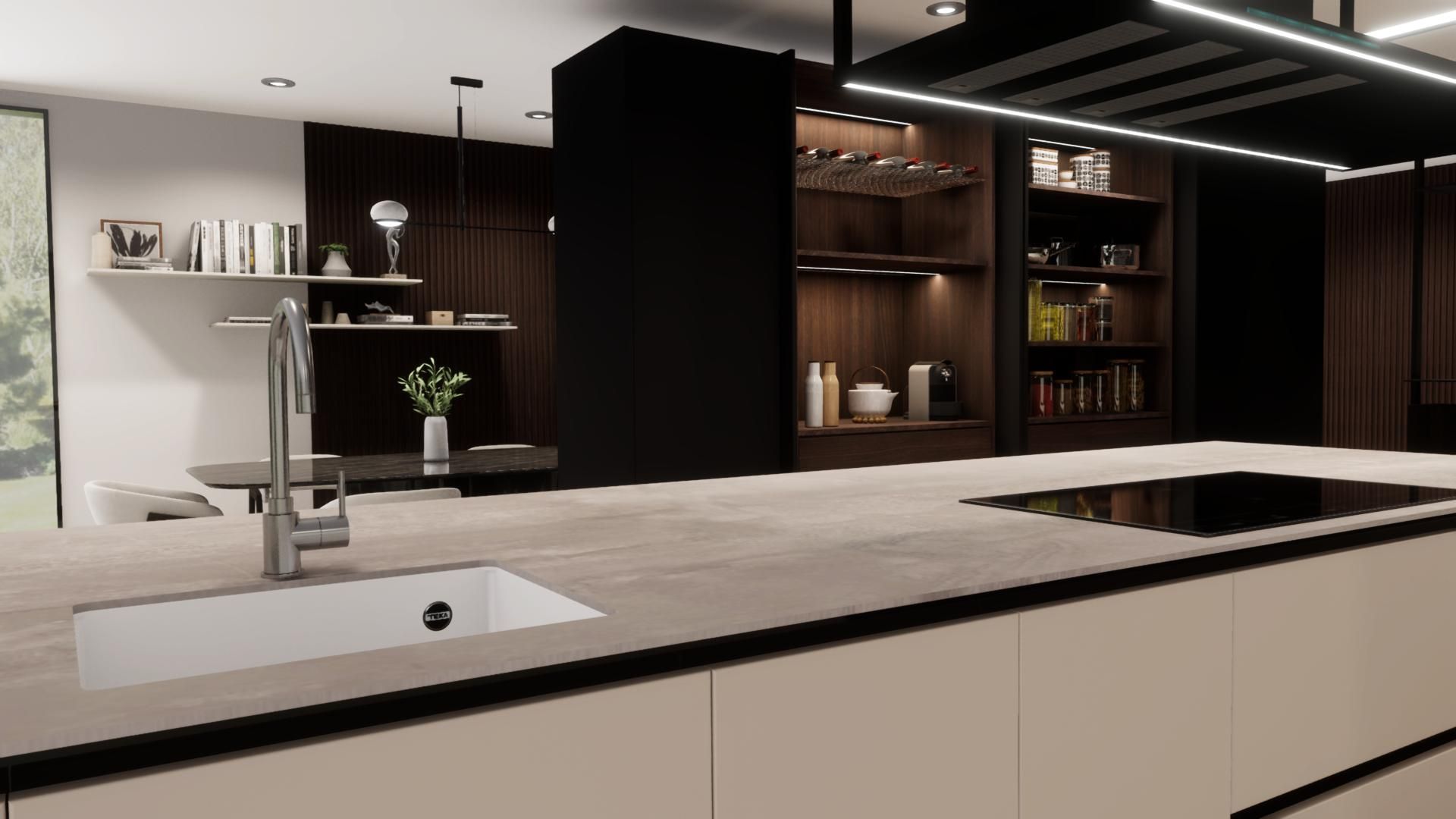
4. The Invisible Skeleton: Interiors and Carcasses
A common mistake is investing the entire budget in doors and neglecting the interior. The carcass is the structure that supports the weight of the dishes and the tension of the fittings.
Moisture-Resistant Board: Mandatory in wet areas (sink). Recognizable by the greenish color of its core. Using standard particleboard here is a short-term swelling risk.
Weight and Thickness: A good cabinet uses 19mm boards to ensure hinge screw retention. In “low-cost” kitchens this is often reduced to 16mm, compromising the lifespan of the fittings.
5. Hardware: The Engineering of Movement
There is no point in having a solid oak door if the hinge fails after two years. Hardware defines the “quality feel” when opening and closing.
Drawers: Always demand full extension and soft-close braking. Load capacity (40kg vs 70kg) is a key technical detail in large drawers.
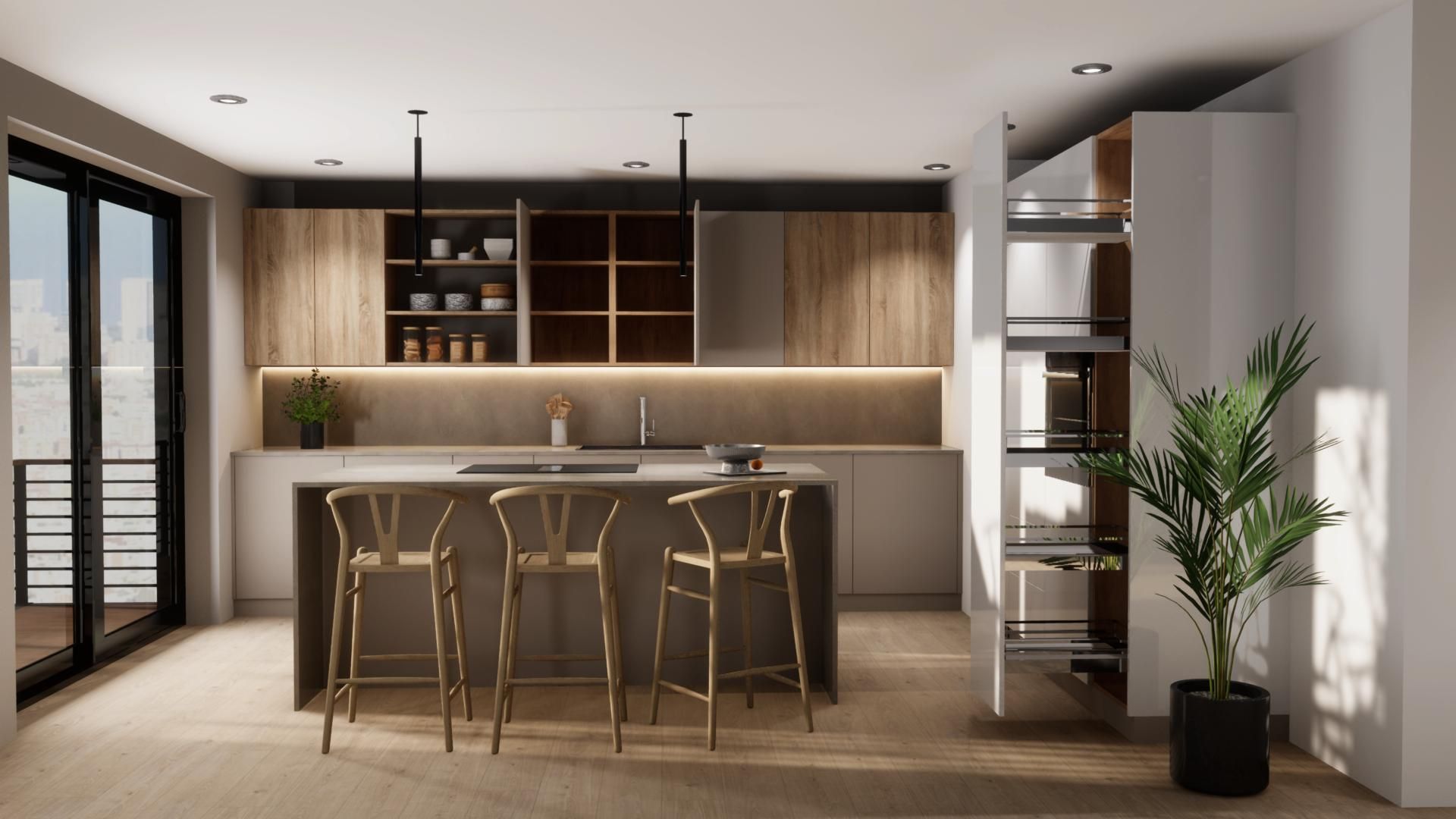
Lift Systems: For upper cabinets, folding systems facilitate access without the door getting in the way.
Our Professional Opinion
Designing a kitchen is an exercise in balance. The best material is not always the most expensive, but the one that best responds to the user’s lifestyle.
For the professional, the challenge is managing this complexity: thousands of references, finishes that change price, and technical constraints (thicknesses, maximum dimensions). This is where integrated management tools such as Teowin make the difference. By having real material libraries connected to manufacturing:
- You validate that the chosen material is suitable for the designed cabinet.
- You obtain the real cost instantly.
- You generate photorealistic renders so the client can “feel” the texture before purchasing.
A well-chosen kitchen is the sum of good design, appropriate material, and precise manufacturing.