
In contemporary interior design, the line separating spatial design from furniture manufacturing has disappeared. Clients are no longer looking for “loose furniture”; they demand cohesive spaces, where architecture and furnishings flow as a single unit.
This forces designers and manufacturers to work in absolute synchrony. However, the reality for many studios and workshops remains one of two disconnected worlds: the creative draws a vision and the technician struggles to make it buildable.
For industry professionals, understanding how to connect these two disciplines is the key to stop putting out fires on site and start guaranteeing precision and profitability. In this article, we analyze how to transform the relationship between designer and manufacturer through an integrated and digital workflow.
Design must be born with the machine in mind
A classic mistake is designing “in a vacuum” and expecting the workshop to solve the technical feasibility later. To truly integrate both disciplines, the project must be conceived with constructive criteria from minute one.
Real Measurements: Forget estimations. A precise survey (laser, point clouds) imported into the design software prevents a poorly measured column from ruining a built-in wardrobe.
Smart Modulation: Thinking in standardized rhythms and proportions does not limit creativity; on the contrary, it allows the manufacturer to translate the design into their technical language (cut list) automatically and economically.
Technical Feasibility: Aesthetics must dialogue with physics. Can that floating shelf support the weight? Is there hardware for that 3-meter door? Designing with technical knowledge drastically reduces improvisations (and extra costs) in the workshop.
Documentation as a common language
Real integration depends on information flowing without noise. A pretty plan is useless if it doesn’t contain the instructions the operator needs. The documentation that makes a difference includes:
Layout plans and critical dimensions.
Constructive details: Specific solutions for joints, connections, and wall finishes.
Material sheets: It is not enough to say “wood”; you must specify the type, finish, pore, grain direction, and supplier.
The Teowin factor: When you use a comprehensive tool, these documents are not drawn by hand one by one. The software automatically generates the technical plans and cut lists from the 3D design, ensuring that everyone (designer and carpenter) sees the same reality.
Digitalization: The bridge between the render and the CNC
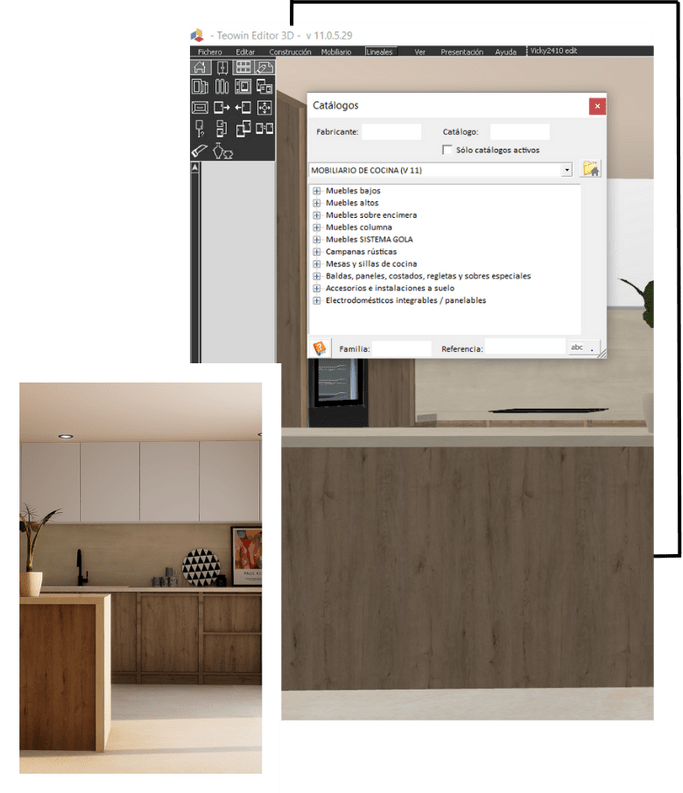
This is where the true revolution takes place. In the past, the carpenter had to “redraw” what the designer sent them in order to manufacture it. Today, tools like Teowin allow you to transform the interior design into ready-to-manufacture components with a single click.
In this integrated workflow you achieve:
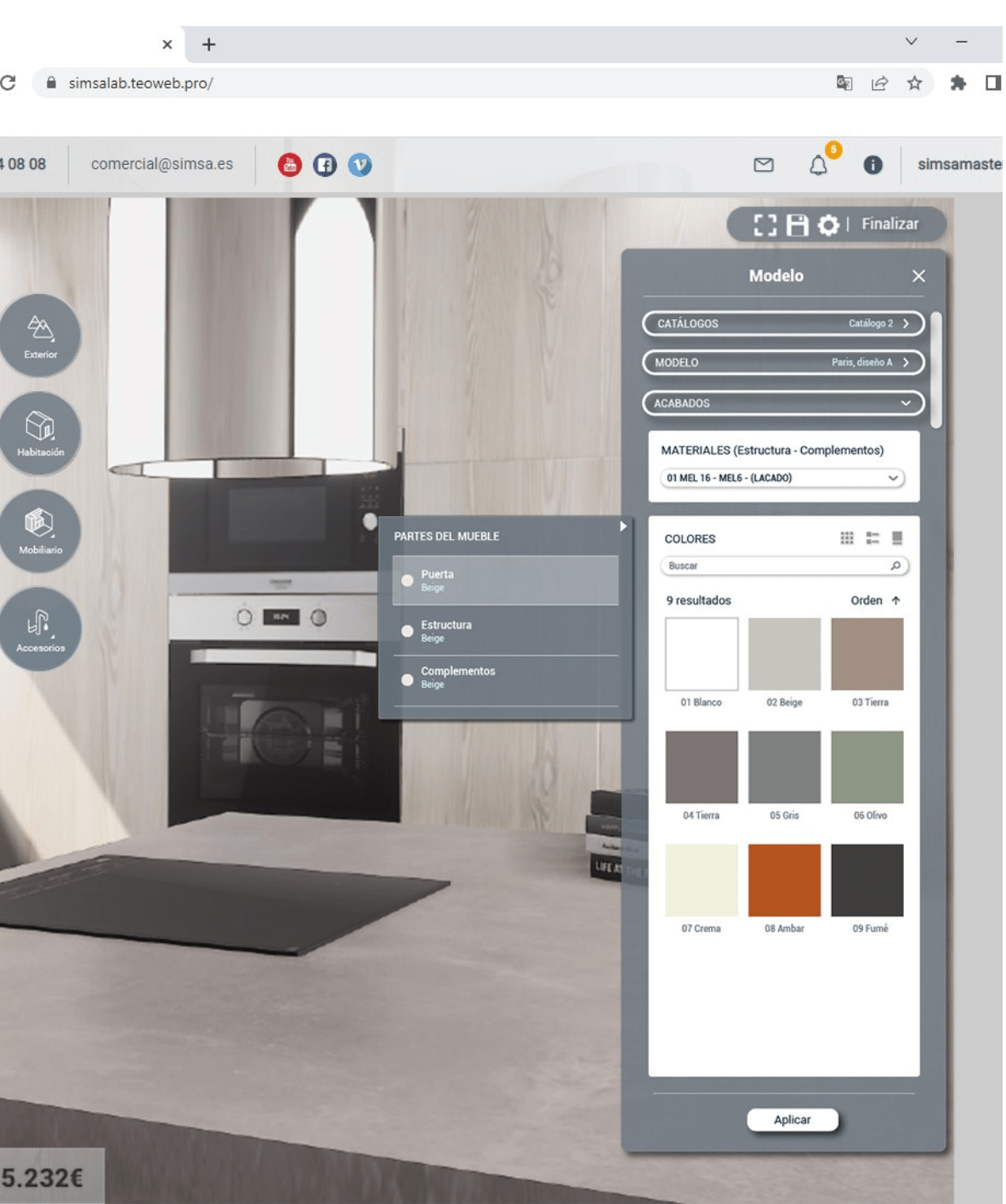
Realistic Visualization: The client sees exactly what is going to be manufactured (textures, lights, volumes).
Parametrization: If you change the measurement of a wardrobe in the design, the cut list, the quote, and the order for the CNC machine are automatically updated.
Cost Control: You know the profitability of the project before cutting the first board.
For an interior design studio, speaking the same digital language as their trusted workshop means eliminating 90% of interpretation errors.
Collaboration: From "Supplier" to "Partner"
Custom manufacturing should not be seen as an external subcontractor, but as an extension of the design studio.
The Interior Designer provides: Spatial vision, aesthetic coherence, user experience, and trends.
The Manufacturer provides: Deep knowledge of the material, production limitations, and engineering solutions for durability.
When both profiles collaborate on the same digital model from early stages, the design evolves with coherence. No more unpleasant surprises of “this can’t be done like this” when it’s already too late to change it.
Materials: Deciding with constructive criteria
Many site failures stem from a purely aesthetic choice of materials. To integrate both worlds, the interior designer must have technical criteria regarding:
Material behavior: Swelling tolerances, moisture resistance, or reaction to light.
Machining: Does that material allow for the type of edge you have designed? Does it splinter when cut?
Compatibility: Ensuring that the chosen thicknesses work with the proposed hardware and opening systems.
A good interior design starts being manufactured from the choice of material, not from the saw.
Installation: The acid test
Even if the design is perfect and the manufacturing flawless, a bad installation can ruin everything. The integration must reach all the way to the client’s home. It is vital that the installation team receives the same technical documentation generated by the software. They must know where the hidden installations go, what clearances have been planned, and how the finishes are resolved. A coordinated installation not only guarantees durability but also preserves the original aesthetic intention.
Our professional opinion
Integrating interior design and furniture manufacturing has ceased to be an advantage to become a necessity. Excellence today is not only measured by the beauty of the render, but by the ability to materialize that vision in a precise, profitable, and durable way.
The professionals leading the sector are those who have understood that design and production are two sides of the same coin. Thanks to tools like Teowin, which unify the creative and productive process, it is possible to close the gap: the interior designer designs with technical feasibility and the manufacturer produces with aesthetic sensitivity. The result is a superior project and a satisfied client.